Tuesday, May 25, 2010

It's a Juki Disastro

NOTE: Scroll down for updates & fixes.

Well, not really a disastro ... I've just been listening to CocoRosie lately.
Though, my brand-new Juki DNU-1541S is still not working and that's close to a disaster.

After hours of contemplation and watching the hook spin round and round I've figured out that the hook assembly is most likely defective, or was damaged somehow at the factory. Either way, there's a rough spot in the rotation of the hook that causes the assembly to seize up when there's enough lateral pressure applied to it.

Hook assembly pictured above. The inside part with the post is called the basket. It rocks back 'n' forth slightly while the hook rotates around it and is held in place by the bobbin case holder.

The first time I was sewing with this machine, I was going slowly over some number-eight cotton duck, everything's going well, beautiful stitches ... sewing over a few more layers of duck on top of that, and then boom! the machine jams up.
I thought it must've been a bad needle strike, or something like that, and the safety clutch went off. But it wasn't that at all. It took me a while to figure it out -- days -- but here's what's going on:

When there's force on the basket, such as when the machine is handling heavy material, the basket and hook lock up. This makes the basket pop outta place and rotate with the hook. (Note the top red arrow above: This is the li'l nubbin that keeps the basket in place [the finger on the bobbin case holder]. With the second arrow, above, you can see the needle coming down through the slot in the basket.)
Here the basket has popped out of place and is rotating with the hook. The needle is continuing to descend...
...and will collide with the basket ... now! Your needle will now be missing its tip and your case opener (that lever on the bottom of the photo) will now be pointing to the right, knocked outta place.

The great tragedy of this is that Juki sewing machines have such a good reputation that no one believes me when I tell them that I'm having trouble with my hook assembly. They usually try to blame the problem on me, or tell me to call someone else ... in circular fashion.
And since this only happens with heavier material, it wasn't caught at the factory during the final sew off.
Fortunately, Juki America has been fairly helpful, and I've sent my hook in for inspection.

Note: I've received my replacement hook and I've just installed it. So far so good. Thanks, Juki! [Keep reading for more updates.]

Though, I swear this machine must be cursed. First I received a defective table leg, then the motor belt was too small to match the drilled holes, now a crummy hook assembly.
Sheesh. Give me a break.
Lucky I still have my Tacsew 111. Almost half the price and sewing strong.

So here's me taking the hook assembly off (don't do it like this -- the whole thing comes off w/o taking it apart):
I was hoping to just move the feed base up a bit and slide the whole assembly out, but the thing's so complicated on this machine, I just took the assembly apart and got it out that way.
[Note: I figured out you can just loosen the bobbin finger/holder (that piece with the nubbin on it) and swing it out of the way and that leaves just enough room for the hook assembly to slide out. That's when the feed dog is at its highest point.]

Above and below is the hook with no basket.
Made a li'l mark on the machine so I can roughly line it back up ... though, there's a groove in the hook shaft...
[Note: Lucky there's a groove 'cause I forgot what position the needle was at. You need another reference point, otherwise this is useless. Ha.]
Needle plate removed. The hook just about to come back up. This is where the hook would snatch the thread loop.
No more hook assembly.

Update (5/10/15)
Probably should've updated this years ago, but I only use this machine occasionally now, mostly just for thick foam applications ... but I've recently received some emails from people with this same problem and seen this problem come up on some forums, so here it is:

After I installed my new hook assembly back in oh-10 I still experienced the dreaded hook jam, though not as much as with the original hook assembly. I've thus concluded that these hooks are bad -- bad to the bone. [If I can't get other hooks in other sewing machines to jam the same way by pushing on the bobbin, and I can with the 1541S, there's definitely something wrong with this hook, but maybe that's just me.] Though, I've figured out a way to work around this issue. First, let's look at the threading diagrams for the 1541 and 1541H (heavy duty):


Above is the threading diagram for the 1541 and 1541S (safety clutch). Note the sliding thread guide (red star). This is used to adjust how much thread goes around the bobbin -- or something like that. I can't find it addressed specifically in the manual.
 

Now look at the threading diagram for the heavy duty class. No sliding thread guide! This is key. Here's what I think is going on:

These machines are set up to sew through a couple layers of upholstery material, and when you go to sew through anything heavier, there isn't enough thread to go around the hook assembly smoothly, putting inward force on the bad bobbin basket, which then binds.

To avoid locking up the bobbin, I've been threading the machine the H way (or similar) with good results. This is how I was threading it the last time I used it, sewing 1/2-inch closed-cell foam and Cordura. I've skipped the sliding thread guide and the square thread guide, leaving plenty of thread to travel around the bobbin.


Notice the sliding thread guide is oriented the wrong way. I'm pretty sure threading it like this will actually take up more thread. I was playing around with different guide configurations a while back. I should set it back the way it was...
Here is another look at the hook assembly and related parts. Juki has a real nice database. You just need to set up a user name and password.


If this happens to you, the hook assembly will catch the needle and the machine will jam. If you're sewing at speed, your needle will shear off. Clean out your ruined needle and thread and turn the handwheel backwards till the hook assembly pops back into place on the finger and then look for issues (you will most likely have to reset the case opener lever (on an S class). You may have to adjust your threading, as shown above. Or it's possible thread has been pulled into the hook raceway and caused the jam.
This might be caused by another issue, brought up by a sewing tech on Upholster.com (2/7/11):

Re: JUKI 1541-S shuttle/hook assembly out of whack, help me fix it!

I know exactly what is wrong, and I can explain how I know; because I check every Juki DNU-1541S before it leaves my shop for this known (by us) issue with this model, out of the box.
I can't tell you how to fix it, as I do not care to go head to head with another sewing machine mechanic. They may have a different resolution to this that I do, and I don't want to get into a tit for tat, he said she said brouhaha.

But, I can tell you what I know for absolute sure; the hook supporting plate/bobbin case finger that holds the bobbin case/inside hook from spinning is hanging on by a finger nail, and does not go in far enough. Unless this is taken care of, this will be an issue that will continue to plague this machine.

I've reset my hook placement before, and tested it by hand to make sure it was solidly engaging with the finger, and still had it pop off. There is quite a lot of force behind that hook when it jams. The finger-placement problem explains why it comes freely on certain 1541s, though -- and is maybe further proof of a larger quality issue with these machines.

And here is a thread on Leatherwork.net where the hook assembly popped free.

I'm hoping, as I use this machine more, the hook breaks in and never does this again. I oil my hook manually now, and I'm pretty cautious when I sew heavier stuff. Hopefully one day I can relax while I use this machine. :)

Update (5/25/16). I've been informed by a sewing machine mechanic that there is a break-in period for hooks -- even high-speed Juki hooks. He recommends turning the hook oiler all the way up.


Update (6/30/20, Year of the Covid). I've had a request on how to adjust the bobbin case positioning finger (that thing with the nubbin that keeps the bobbin basket in place).

The idea here is that you want the nubbin to go into the bobbin-basket notch far enough to keep the basket in place if there's some friction in the raceway, but not too far that there's no room for the thread to pass around the nubbin. You'll probably have to do this through trial and error. It's possible that if the basket has popped out a lot, your nubbin may have been damaged and you'll need to secure a new finger.


Here's what that finger looks like outside of the machine:

And here's where the screw is that allows you to adjust the finger. Again, don't take your hook apart to get it out ... just remove the finger.

Good luck!


Monday, May 3, 2010

Win a Musette Bag!

>>>Update<<< The bag has been spoken for.
You may now continue reading the post:

Well...maybe "win" is the wrong word...
My friends are raising money for their friend's son, who has a rare respiratory disease. The money will go towards medical travel expenses.

Learn about their efforts here: Running For Ayrie.

So...the first person to donate 50 dollars gets a coupon for one free musette bag (aka a tiny messenger bag) made by me.
This is a semi-custom bag, so you get to choose the fabric color (from what I have on hand) and something simple to be appliqued on the bag's flap. I'm thinking simple shapes, like stars, clouds, squares, half moons, and such. No names or anything too complicated...unless your name is Al, or Oz.

Your bag'll look something like this:
Sans horse.


These are nice little everyday bags, for when you don't need to carry too much stuff.
They measure about 15" (across the top) by 11" (deep) by 3" (thick, at the bottom).
They have one outside front pocket, and one inside pocket with pen slot.
If you ask nicely, I can change up or add more pockets...within design reason.
They will be made outta Cordura nylon, or cotton duck--your choice.

I'm not taking orders for custom bags right now, so this is a unique opportunity to get a semi-custom bag.

Again, visit Running For Ayrie to support a good cause.
Learn about how these bags are made and designed here.
And if this is your first visit to this blog, learn about Leif Labs here.
Thanks.
cory/Leif Labs

Xtracycle Upgrade

Just got some sweet new parts for my Xtracycle...
Yes! wings. Hopefully these will allow me to go even faster.
And...
Awesome handlebars!
And thus ends this chapter of my quest to make the most awesomest (or goofiest) bicycle in town.
Oh, I also put a shorter stem on this thing. I had to get a downhill stem, though. Why is it so hard to find short "regular" stems (for cheap)? Hmm...
I'll be on the lookout for some sweet fenders next. Maybe those hammered-metal ones from Velo Orange. Mmm...

Tuesday, April 27, 2010

Leif Labs Goes to Boonville

My friend Tim and some other peeps went on a bike camping trip last week, and he just sent me some photos of his panniers in action. They're the waxed cotton ones on the front.
The older super-capacity pannier...for carrying as much shit as you possibly can.

Lookin' good.

Singer 20U73

Okay...the last sewing machine I'll be buying for a while...unless I see a sweet deal on an old industrial that I can use for a dedicated binding machine...but that's a ways away, methinks...unless I decide I don't want the 146B anymore...and an industrial serger would be nice, too...
Anyway, behold! the Singer 20u73:
Bring on the mother-effin' applique! Ha...
The 20u class has been around for quite a while and I've been looking for one of those nice blue ones from Japan on eBay with almost no luck. I was close to winning one last month, but I wasn't paying attention at the end...so it goes. The seller said nothing of the condition of the machine, so maybe it was for the best. Though, what I really want is one of those clear-coated laminated sewing tables. So nice!
I never thought I'd actually ever buy a new Singer machine, but I did. There are so many copies of this machine, it's crazy. I think Industrial Sewing Machine Man has at least eight machines on his website. Consew, Tacsew, Reliable and Artisan all have copies. Artisan has one with an oil pump, which looked cool. And the Reliable seems like a real good deal...if you order it from their website. You get a plywood table, their servo motor, and a pretty swift light. I'm not sure if it's the same deal if you order it from Sewing Man...though maybe.
But I decided to go with the original...it was just a little bit more.
I have three other machines that do zigzag...my 146B, Ultrafeed, and Kenmore. The Kenmore's not industrial, so throw that out. And the other two are too clunky to do applique for any length of time without going crazy. Plus they're way too heavy for lighter stuff, like 200d nylon.

My back is pretty pissed that I helped the FedEx man carry this onto the porch. I was too excited to think of taking the head off the pallet first. (This photo was obviously taken after I cut the plastic off and removed the head.)
I usually prefer to set up my own table, but it was the same price to have it shipped assembled (somewhat). It probably would've taken just a little bit longer to put it all together outta the box, though. I still had to adjust the height and move the pedal over and drill holes for the knee-lift mount and thread stand. And the rest-peg hole isn't drilled either. But I guess it's nice that they put the motor on there for me. And the drawer.

Box.
Oh sweet, I get some fancy feet. And just two extra bobbins? What the hell. I guess a lot of people probably use prewound bobbins...
Oh nuts, is that the knee-lift mount there? I already turned the table over...
Thanks, K, L, M!
The bobbin (left) for this machine is strangely slim...though not as slim as, say, a Singer 221's. I was hoping my cache of extra bobbins for my Kenmore and Ultrafeed would fit, but they don't. Boo.
Some test stitches, by me--not Tang. I'm excited about on-the-fly width adjustment. Yeah.
Oh, the hook's made in Japan!...as with most every other Asian-made machine. This machine (and all 20u copies, I believe) was made in China. You can see that real small on the back. Ha. The quality of casting and machining looks pretty good on this machine, though. I'm not thrilled with all the plastic levers, though. C'mon. I have to say, though, the action on the stitch length- and thread tension knobs are the best of any of my machines. So nice.

This machine is soo simple compared to my upholstery machines. I like that.
Top.
I think this is a Family brand servo motor...something like that. I think it must be a Tacony house brand. It seems okay so far. It's the most growly of all my servo motors, though. And it has a brake...but it doesn't work as well as the SewStrong's, so it's okay. Ha. (I don't like brakes on my motors--I live dangerously.)
You'll notice I don't have the belt on here. It's outside airing out. It's made of that same gross black tar as the SewStrong's. Boo. I can't stand that smell.
You can either have the knee-lift lift the foot or change the stitch width (bight). I have it set up to lift the foot. I don't plan on doing any intricate embroidery at the moment.

Under.
Hook.
Gears.
Lab 2.
A Singer copy and the real thing.

Sunday, April 25, 2010

Juki DNU-1541S

Well, I finally bought one: the mother of all sewing machines--the Juki 1541S (the "S" stands for safety clutch).
As far as I can tell, the Juki 1541, the Consew 206 (Seiko STH-8BLD-3) and the Tacsew 111w (modeled after the Singer 111w) are some of the most popular machines in the bagmaking and upholstery world. Of course, there are about a million other machines out there similar to these (Pfaffs are big in the upholstery biz, but new ones are ex-pen-sive!). All of these machines have compound feed (needle-feed, walking-foot...aka unison feed) and a large bobbin, making them awesome for sewing medium-heavy materials. (In the world of industrial machines, there are even heavier machines, for sewing leather and thicker upholstery and webbing.)

I was using the Tacsew 111w before and it's a great machine. I love its simplicity and (mostly) smooth operation. The only thing was, I wasn't able to adjust the foot lift and sew over thicker materials, which I've been doing more with the #8 cotton duck I've been using. When you adjust the foot lift, a part on the foot bar (I don't know what the technical name is--my manual's over across the room) runs into the thread uptake mechanism and jams when you sew over a certain thickness of material. This sucks. I like to have a higher lift on my feet because I need to sew over a lot of uneven material, and when the feet don't lift high enough they drag on the material and foul up the stitch length.

Hopefully this won't be the case with the Juki, as it has a higher lift (I'm excited about sewing through foam) and being able to adjust the feet lift/alternating-movement is one of its selling points.
I wonder if the body on the 111 was designed for compound feed or if they just took it from another machine. It's a pretty popular body type...but the Tacsew 111w is the only compound machine with this body. Every other compound feed has a larger area for the needle bar, feet bars and thread uptake mechanism...even the Singer 111w, which the Tacsew ostensibly replaces (I don't know when Singer stopped making this...their compound machine now is the 4411a).
If they did skimp on the body, they've severely limited an otherwise great machine...bastards.
But it is a relatively inexpensive machine...
Anyway...on to the Juki...

I'm pretty happy about having a legible and informative manual and parts list. The 111's manual barely makes sense...and one of the pictures in the parts list isn't even the correct machine (!). Ha.

Please don't throw away your Juki.
Thanks, M.

All right! Juki-brand wrench!
The Juki comes with Groz-Beckert needles, which I've been using lately. The sewing kit from Westchester comes with Organ, which I've used in the past. Before I got G-B needles, I was using Schmetz. It seems like the G-Bs hold up a little bit better if you're sewing #8 cotton duck all day long...but other than that, I can't tell that much difference between the three.

By the way, I ordered my machine and table from Westchester Sewing. I'd ordered some other things before from them and decided to see what ordering a machine was like.
I've also ordered two machines from Industrial Sewing Machine Man, which has been pretty good (they're drop-shipped from Tacony in the Midwest). Their 1541 price is almost the same as Westchester...which is to say it's cheap.
I've also heard good things about Keystone Sewing Company. Of course, as with the choice of brand and machine type, there are about eight million places to buy one (though I'd guess they probably come from only a handful of warehouses).

Putting the table together...that looks about right...

A servo motor comes standard with the Juki. I love punny sewing products. Ha.
Unfortunately, the motor has a brake on it, which I don't like. I use the hand wheel a lot when I sew, so to do that easily with this motor you have to press on the pedal a little bit. (I fixed this by just taking the cork brake pad off.) It makes me uncomfortable to have my hand on the wheel and on the pedal at the same time, so I slapped on my brakeless SewQuiet servo motor:
The SewQuiet has a smaller pulley, anyway, and I'm a big fan of sewing real slow. Ha.
Ironically, the Sew Strong seemed a little bit quieter than the SewQuiet (though I've used neither motor very much...and never on very thick fabric). The SQ has developed that annoying high-pitched electronic tone (it's really not that loud, though). Maybe it'll go away...

Puttin' in the drip tray. One thing that irks me about this setup is the space under the machine where you reach in and get the bobbin out is super small. I feel bad for anyone with larger hands. Maybe it's just the table, though. I'll have to file some of the wood away.
Oil collector bottle. This is a different design from what's in the manual. This is the time where I go, "Oh shit, I'm missing parts!" But everything worked out. Ha.
Okay, how am I going to get that out of the box and onto the table? This box weighed 110 pounds! Damn!
Come on out, you!
So Westchester drilled all the holes in the table for me, which is awesome (they did an okay job...I had to widen the light hole a bit). Last time I ordered a table from Sailrite: no holes drilled = no fun. You need a pretty big bit (which I don't have) to drill the thread post and the little peg the machine rests on when you tilt it back. Unfortunately where they put the motor meant I couldn't use the included belt. Too short! by an inch. That's okay...it smells like tarry marijuana (that's bad). "Hey! why's my room smell like weed!" It's that black belt up there. I was hoping the white belt would work, but it's too long. And I had a piece of this magic belt that came with my Sailrite 146B copy, but it was too small too...so I ordered a bit more offa eBay.
This is Fenner Power Twist belt, size 3L...that's 3/8" at the top.
It's pretty crazy stuff. Read what they say about it at Lee Valley.
It's suppose to be the absolute shit for running high-speed woodworking tools. I don't know it the benefits translate to the sewing world, but it is adjustable, strong, and cool-looking.
The Lee Valley stuff is the wrong size, though. Sailrite does sell it, but you can get it for half the price on eBay...from ohioblademan...or something like that. Ha. It's still three-times the price of a regular belt, though.

Drink up, little machine. I knew this funnel would come in handy some time...
That's a little oil-filled gear box. The 111w sits in a vat of oil, which gets messy sometimes.

Nuts! I've already fouled up my machine somehow. That little lever betwixt the red arrows is the bobbin case opener lever (aka the opener). As you can see, it's nowhere near the tab on the bobbin case/inner hook (left arrow) that it's suppose to press on. It got knocked out of place when the hook assembly locked up...so I reset it:
Loosen up the lever bar...
And move it to where it's suppose to be. The instructions aren't entirely clear to me on how you're suppose to do this: it mentions "clicks" and stuff...which I'm not certain of. I guess these are the clicks the inner hook makes when it opens and closes.
So, if you don't know what this is (like I didn't--this is my first machine with a case opener) a case opener makes sure the bobbin case is open at the top when the thread loop is coming out and forming the bottom stitch. Sometimes on a rotary machine, when you're using heavy thread, the bobbin case doesn't want to open and you can get a jam. So the opener, well, makes sure it's open. Some machines (like some Singers) have timing marks on 'em so you just line it up with the marks if it comes outta time. I just eyeballed it. As you can see above, the thread is moving around the bobbin, from left to right. It has to make its way between the lever and the case, and then the lever has to push on the tab to keep the case open:
Like so. Press on that tab! You can see the black thread on the upper right about to go up and form the bottom stitch. Hopefully I did this right. There's suppose to be like a 0.8mm (!) gap between the lever and the case tab at the lever's leftmost position. I think I left a slightly larger gap, so we'll see how it works. I still haven't sewn a bag on this yet, but I'm about to make a backpack, so we'll know soon.
Though, my 111 doesn't have one of these levers and it makes out okay...and I don't think the 1541 (no "S") does either (based on the one photo I've seen). So who knows...

I like the Juki's open design...unlike the 111's. Who knows what goes on in that machine. Ha.
As you can see on the right side, the Juki has a timing belt (that thing with yellow writing, which connects the top and bottom shafts). This gives it a somewhat sluggish action, I guess you would say. The 111 has a gear drive and feels somewhat looser while hand turning the fly wheel. Not a big issue... Also, the Juki is wick-oiled, while the 111 has a pump (plus wicks).
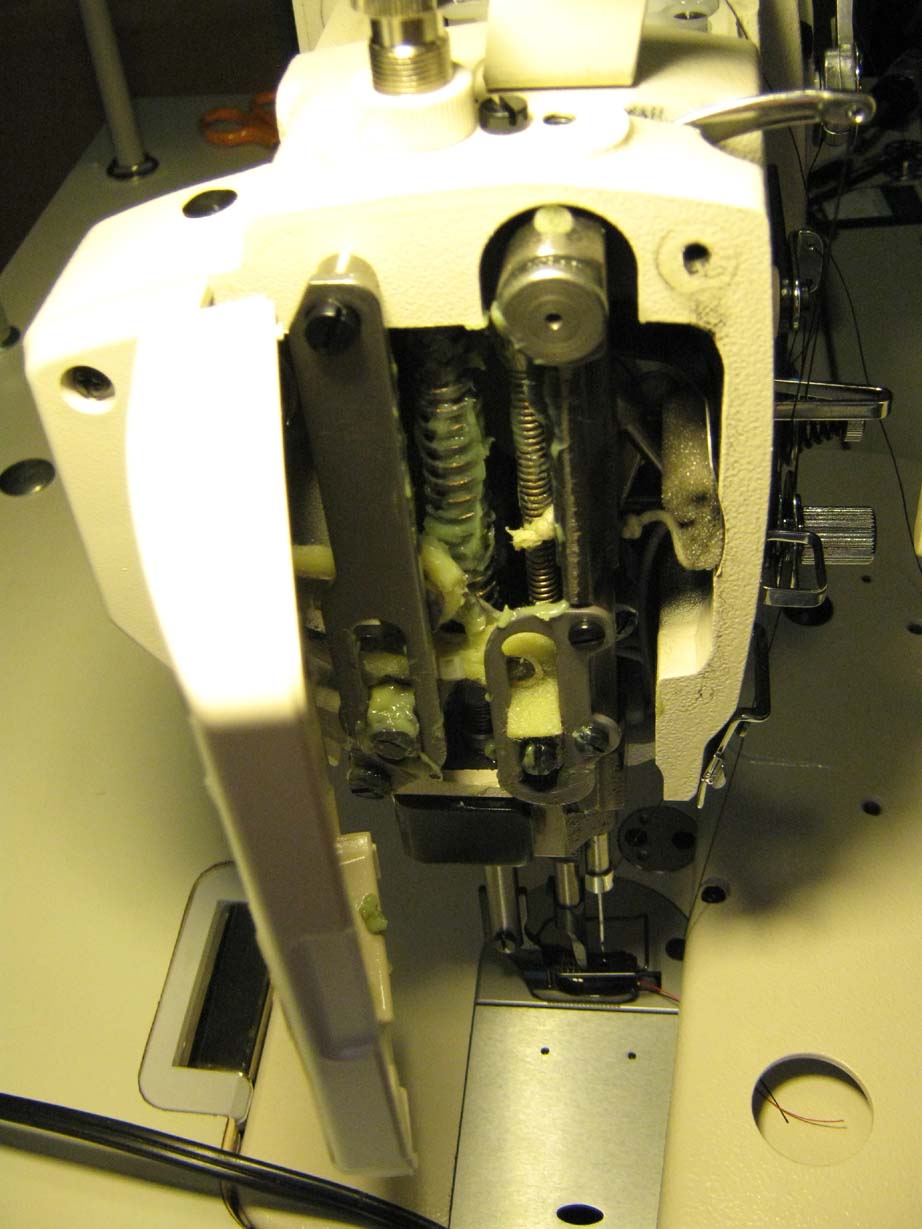
Ah! it's full of goo.
And this is what makes the Juki really nice: the little details. Look at this cute head cover!

Anyway, I'm pretty excited about this machine. I hope it's everything I've dreamed of--and more! (Meaning: hopefully I shouldn't've got a Seiko instead. Ha.)
I still have to build a table extension, too. And I think I'm going to move the light to the front. The light neck's not long enough to shine on the front--where I want it.

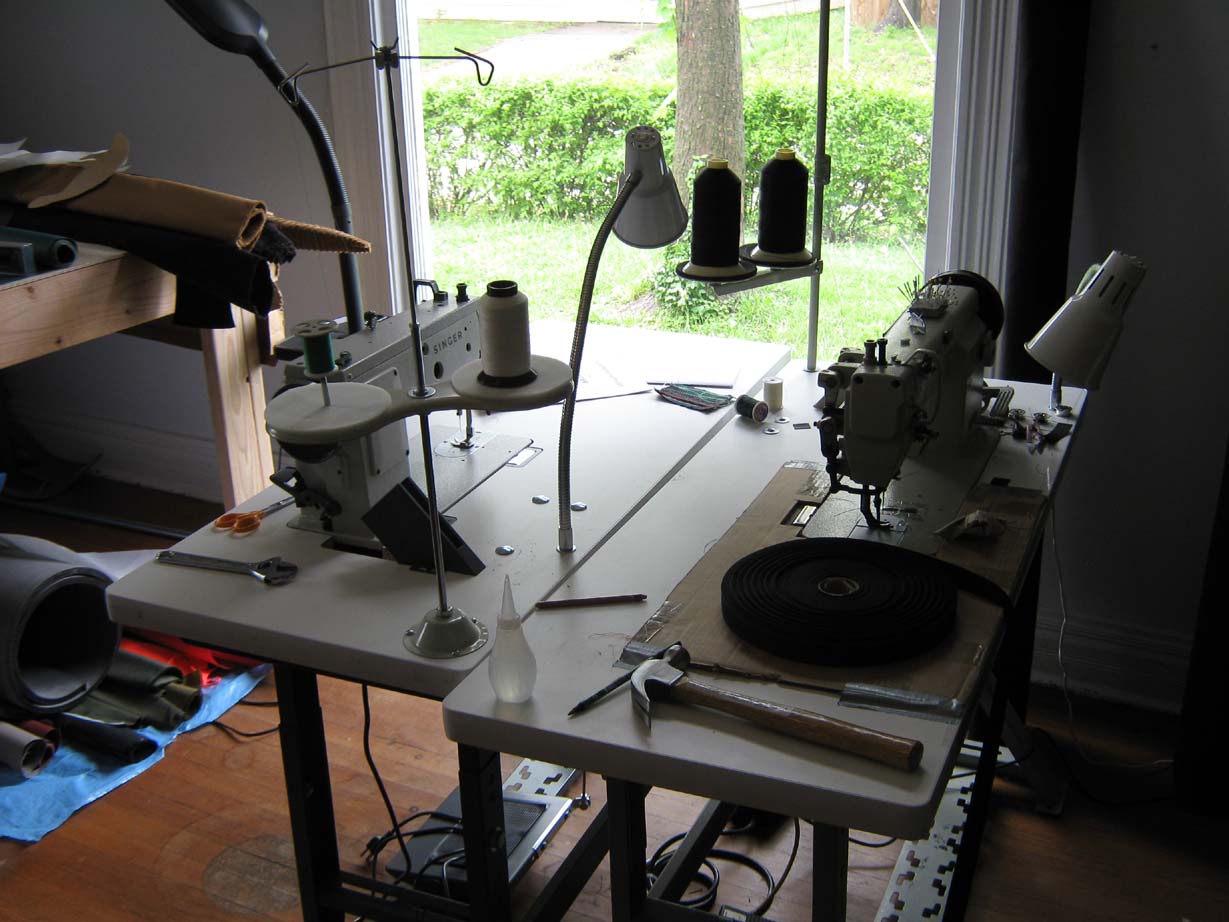
Up next: my new Singer 20u73. Maybe tomorrow...